
Inline Magnetic Separators and Oil-Water Separators for Industrial Fluid Systems
In any coolant or process fluid circuit machining ferrous metals, two contamination streams arrive simultaneously: ferrous particles from the metal removal process, and tramp oil from machine lubrication, hydraulics, and way oil that migrate into the coolant sump. These two contamination sources have different capture mechanisms — ferrous particles require magnetic force; oil droplets require coalescing separation — and both must be addressed to maintain process fluid quality.
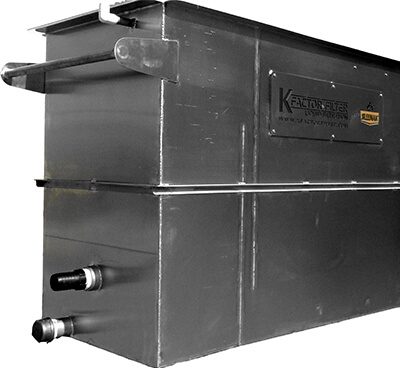
K Factor's inline magnetic separators (GT-MAG, PAC-MAG) address ferrous particle contamination continuously and automatically without consumable media. The K Factor OWS (oil-water separator) addresses tramp oil contamination using triple-compartment coalescing technology that achieves 99%+ oil-water separation efficiency. Together, they represent the complete contamination management solution for coolant and process fluid circuits.
Inline Magnetic Separators — GT-MAG and PAC-MAG
Selecting the right inline magnetic separator
The choice between GT-MAG and PAC-MAG depends on three factors: required ferrous capture fineness, fluid type and flow velocity, and whether the separator is used as a standalone system or as part of a multi-stage magnetic separation circuit.
K Factor Oil-Water Separator — Triple-Compartment Coalescing
Tramp oil contamination in industrial coolant is the leading cause of coolant degradation, biological growth, and foam — all of which degrade machining performance, require increased biocide dosing, and accelerate coolant replacement cycles. The K Factor oil-water separator removes tramp oil from coolant and process water using a three-compartment coalescing design that achieves 99%+ separation efficiency without chemicals, without filters, and without operator intervention.
How the K Factor OWS works
- Oily liquid enters the first compartment through the inlet header. In the first compartment, heavy solids settle to the bottom and free oil begins to rise to the surface.
- A submerged partition forces fluid to the floor. The liquid must pass under a partition that is open only one inch above the filter floor. Since oil floats on the surface, this partition prevents the majority of free oil from entering the second compartment — mechanical oil separation using gravity and density differential.
- Fluid rises through polypropylene coalescing media. In the second compartment, the fluid flows upward through blocks of polypropylene coalescing media. Oil droplets that are too small to rise by gravity alone attach to the coalescing media surface, grow larger by combining with other droplets, and then rise to the surface where they are captured.
- A final oil-free compartment delivers clean fluid. The cleaned fluid flows into the third compartment for return to the process — free of tramp oil and separated solids.
OWS models
- OWS-25
- Standard flow model — flow rate matched to application
- OWS-50
- Higher flow capacity model
- Manual skimmer
- Basic oil skimming for light tramp oil applications
- Automatic skimmer
- Fully automatic oil removal with level-controlled discharge
- Construction
- Polypropylene coalescing media; corrosion-resistant housing
OWS performance
- Oil removal
- 99%+ separation efficiency for free and dispersed (non-emulsified) oil
- No chemicals required
- Purely physical separation — no chemical addition or disposal
- No filter replacement
- Coalescing media is permanent — no scheduled replacement
- Customised
- Each OWS is configured for site-specific flow rate and oil loading
- Applications
- Machining coolant, grinding fluid, parts washing, compressed air condensate
The K Factor OWS is available as a standalone system for tramp oil control, or integrated with the inline magnetic separators to provide complete ferrous particle and tramp oil removal in a single process fluid circuit. K Factor engineers design the integrated system for each application — matching flow rate, separation efficiency, and fluid chemistry to the specific coolant and process conditions.
Applications — Inline Magnetic and OWS
CNC machining and grinding coolant — combined magnetic + OWS
In a CNC machining or grinding facility running ferrous metals, coolant carries both ferrous particles (from metal removal) and tramp oil (from machine lubrication). Installing a K Factor inline magnetic separator upstream of the coolant filter and a K Factor OWS on a side-stream captures both contamination types simultaneously — maintaining coolant at the cleanliness level that protects tooling, maintains surface finish quality, and maximises coolant service life.
- —Ferrous removed by: GT-MAG or PAC-MAG inline separator before the media filter
- —Tramp oil removed by: OWS on a side-stream — returning oil-free coolant to the sump
- —Media filter: Handles only non-ferrous fine particles — media consumption falls 50–80%
- —Coolant life: Extended 3–5x with ferrous particles and tramp oil both controlled
Automotive degreasing and E-coat pretreatment
In automotive pretreatment lines, degreasing baths accumulate metallic fines and machining oil removed from the vehicle body panels. The PAC-MAG's 0.6 Tesla (6,000 Gauss) field strength removes metallic particles from the degreasing fluid continuously — capturing over 85% of ferritic particles down to 5 µm, the fine fraction that conventional drum separators miss. The combined PAC-MAG + OWS system on a degreasing bath circuit maintains bath chemistry, extends bath life 2–3x, and eliminates the regulated waste stream from frequent bath dumps.
Compressed air condensate and facility drainage
Compressed air systems generate oily condensate — water mixed with compressor lubricating oil — that must be separated before discharge. K Factor OWS systems sized for compressed air condensate flow achieve the below-10 ppm oil content required for compliant discharge under US EPA regulations, Canadian provincial standards, EU Water Framework Directive, and Gulf Cooperation Council environmental regulations.
- —Compliance standards: US EPA oil-water separator performance standard; Canadian CCME; EU WFD; GCC environmental regulations
- —Discharge quality: Below 10 ppm oil content — compliant for municipal drain discharge in most jurisdictions
- —No chemicals: Physical coalescing separation — no chemical addition required, no chemical waste generated
Service Locations — Inline Magnetic & OWS
Still running media filters that consume rolls every few hours in grinding?
K Factor's 30-day free trial is available for magnetic separation systems. We assess your ferrous particle loading, fluid type, flow rate, and downstream filtration system. We commission the appropriate GT-MAG, PAC-MAG, or K-Drum inline in your circuit. You run it for 30 days and measure the reduction in media consumption, coolant clarity, and tool life. If the results don't justify the investment, return the system. No invoice. No commitment.
Available to qualifying facilities in the United States, Canada, UAE, Saudi Arabia, and other markets.